
EcoGestor Legislation

greenwashing directive

New Directive (EU) 2024/825 and the approach against greenwashing: what is it and what implications will it have for businesses?

New Directive (EU) 2024/825 and the approach against greenwashing: what is it and what implications will it have for businesses? 1200 800 Eurofins EcoGestor

Directive (EU) 2024/825 of the European Parliament and of the Council of 28 February 2024 has been adopted with an ambitious and strategic objective: to empower consumers for the green transition through better protection against unfair commercial practices and clearer and more reliable information on the environmental and social characteristics of goods and services.

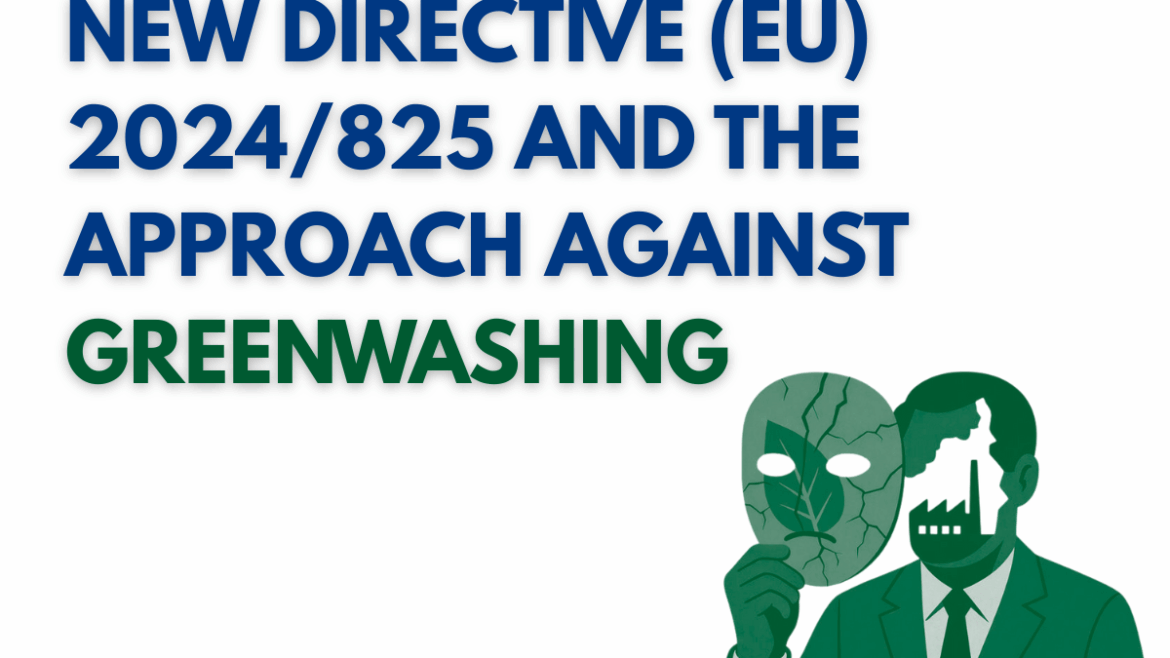
This new European framework essentially strengthens the fight against so-called greenwashing — marketing practices in which companies provide ambiguous, exaggerated or false information about environmental benefits to attract customers — and extends the obligations of transparency and truthfulness in commercial communications.

What does the Directive consist of?

The Directive mainly amends two key pieces of EU law:

  • Directive 2005/29/EC on unfair commercial practices and
  • Directive 2011/83/EU on consumer rights.

Its approach is twofold:

  1. Protection against misleading practices that make it difficult for consumers to make environmentally responsible purchasing decisions, such as:
    • Misleading environmental or social claims about products (e.g., ‘eco-friendly’ without objective backing).
    • Unclear or difficult to verify information on characteristics such as repairability, durability or recyclability.
    • Ambiguous comparisons between products that may be misleading.
  2. Improvement of the pre-contractual information that companies must provide before purchase, especially in relation to:
    • the availability of more sustainable delivery options,
    • information on repair and after-sales services,
    • details of durability guarantees or the conditions for software updates on digital goods.

Together, these measures aim to enable consumers to compare and choose products in a more informed and sustainable manner, and to enable companies to compete on the basis of facts — not ambiguous claims — about sustainability.

What is greenwashing and how does this Directive combat it?

Greenwashing refers to marketing practices in which a company presents its products or services as more environmentally friendly than they actually are or uses vague terms without verifiable support. The Directive acts on two fronts here:

  • Extends the practices considered unfair when they mislead consumers about environmental benefits.
  • It requires that environmental claims be backed by clear, objective, publicly verifiable commitments accompanied by implementation plans with allocated resources.

This implies that a company cannot simply claim that a product is “environmentally friendly” or “neutral” without providing verifiable and accessible evidence of how that conclusion was reached.

Key deadlines for companies in the EU

  • Transposition deadline:

Member States must transpose the content of the Directive into their national legislation by 27 March 2026.

In Spain, this process has already begun with the drafting of the Preliminary Bill on Sustainable Consumption, which will serve as a regulatory instrument to adapt Spanish law to new European requirements on environmental information, combating greenwashing and protecting consumers.

  • Effective application:

The rules may be applied from 27 September 2026, the date on which penalties or contract exclusions may be imposed for failure to comply with the obligations arising from the Directive.

This timetable is key for companies to prepare in advance and adapt their communication, labelling and environmental information management processes. ental.  

What obligations will companies have?

Companies operating in the EU market must:

  • Ensure that all environmental or social statements are clear, verifiable and reliable.
  • Avoid ambiguous or unsubstantiated claims that could mislead consumers (greenwashing).
  • Provide detailed and accessible information on relevant characteristics of the product or service — including aspects of circularity and sustainability — prior to purchase.
  • Facilitate objective comparisons between products when environmental data is included.
  • Include information on repair, durability, availability of parts and after-sales services, where applicable.

Furthermore, traders may be required to verify certain claims through independent third-party experts, especially when referring to specific sustainability objectives or targets.

Conclusion

Directive (EU) 2024/825 represents an important step by the European Union to combat greenwashing and strengthen consumer rights in their transition towards more sustainable consumption patterns.

For companies, this implies increased obligations in terms of transparency, verification and reporting of environmental and social information, with a direct impact on communication, marketing and regulatory compliance strategies.

Is your company ready to comply with Directive (EU) 2024/825 and avoid penalties for greenwashing? Contact us for expert advice.

Legal requirements

Do you know what legal requirements are and how to ensure compliance?

Do you know what legal requirements are and how to ensure compliance? 1200 800 Eurofins EcoGestor

In an increasingly regulated business environment, complying with legal requirements is no longer an option, but a strategic necessity. This obligation goes beyond avoiding penalties: it is the foundation on which the reputation, sustainability and competitiveness of any organisation are built. But how do you identify all applicable requirements and ensure compliance effectively?

Legal requirements: the regulatory framework that ensures your business viability

Legal requirements are the set of laws, rules, regulations and ordinances that regulate business activity. They aim to ensure that organisations operate in an ethical, safe, sustainable and legally compliant manner. These requirements vary depending on the sector and type of activity, and can cover areas as diverse as:

  • Environment: waste management, emission control, dumping, energy efficiency and pollution prevention.
  • Occupational health and safety: safe working conditions, occupational risk prevention and staff welfare.
  • Quality: compliance with management standards such as ISO 9001 or sector-specific standards to ensure excellence of products and services.
  • Data protection: compliance with the General Data Protection Regulation (GDPR) and other privacy regulations.
  • Industrial safety: technical supervision of facilities, machinery, processes and compliance with sector-specific regulations.
  • Food legislation: compliance with health and hygiene requirements, traceability, labelling and food safety regulations applicable to the entire agri-food chain.

Specific requirements according to regulated sectors

  • Rail and aviation: compliance with state regulations on operational safety, maintenance and infrastructure management.
  • Construction: adaptation to legal requirements on structural safety, sustainability and working conditions on site.
  • Electricity and hydrocarbons: compliance with technical and safety regulations relating to energy installations, supply and transport.
  • Tourism: compliance with specific regulations on safety, accessibility, sustainability and quality in the provision of tourism services.

These regulatory frameworks not only define how a company should operate, but also shape its minimum obligations to ensure responsible and legally compliant development, adapted to the particularities of each sector of activity.

From a practical point of view, a legal requirement is what your company must do to comply with current legislation. It may be a specific action, a preventive measure, a mandatory documentation or a technical assessment. This is where many organisations face the challenge of correctly interpreting what each regulation requires.

How to comply with legal requirements effectively?

Complying with the law should not be a complex task if a proactive approach is taken. Companies that excel in this area do so through systematic management, including:

  • Regulatory identification: analyse which laws and regulations apply to the specific business activity.
  • Legal impact assessment: understanding how these regulations affect internal processes.
  • Implementation of corrective measures: adapt operations, procedures and human resources.
  • Regular auditing and monitoring: review the degree of compliance and prevent deviations.
  • Continuous updating: anticipate legislative changes that may affect the sector.

EcoGestor Legislation: clarity, control and compliance at your fingertips

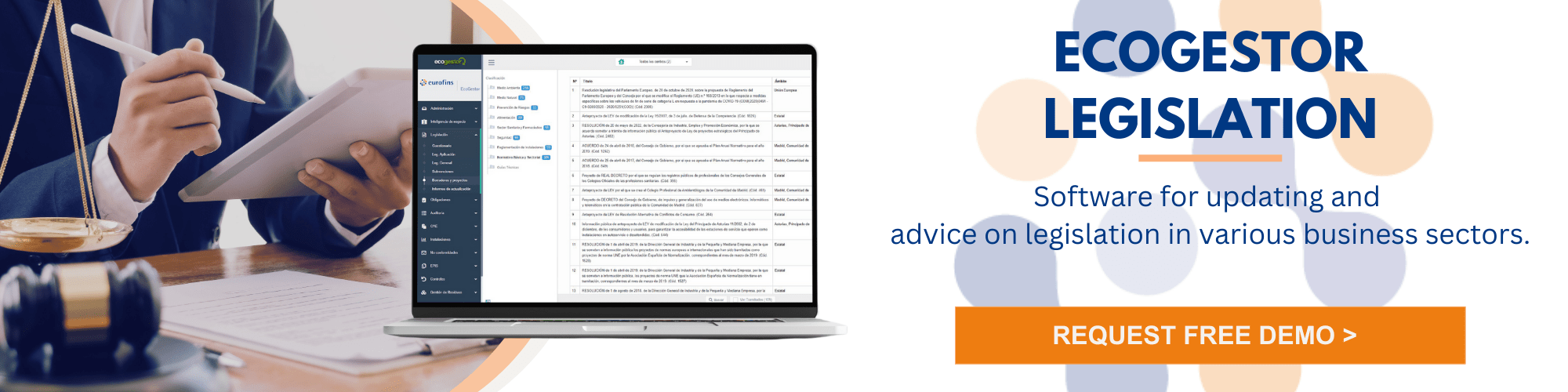
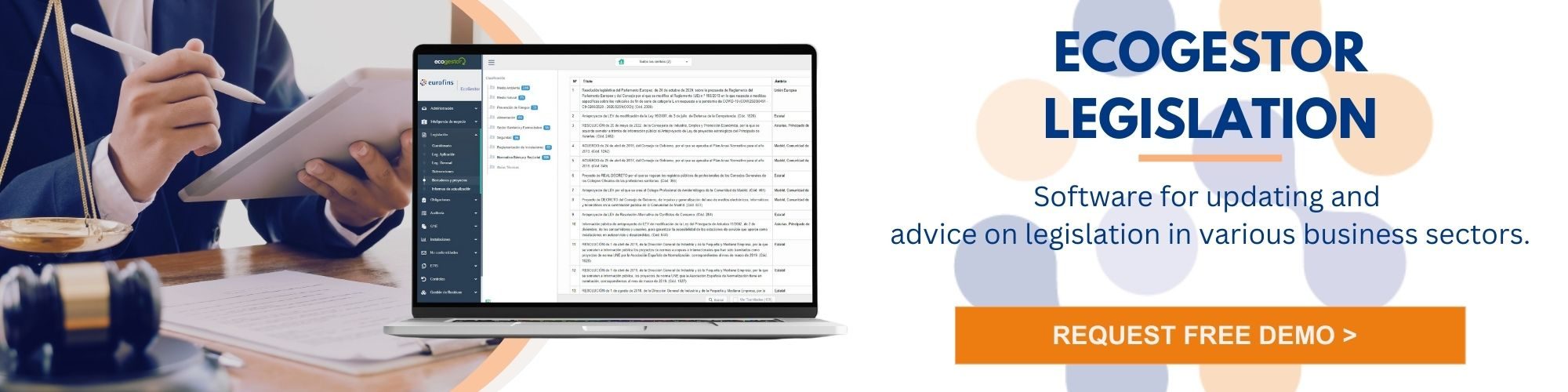
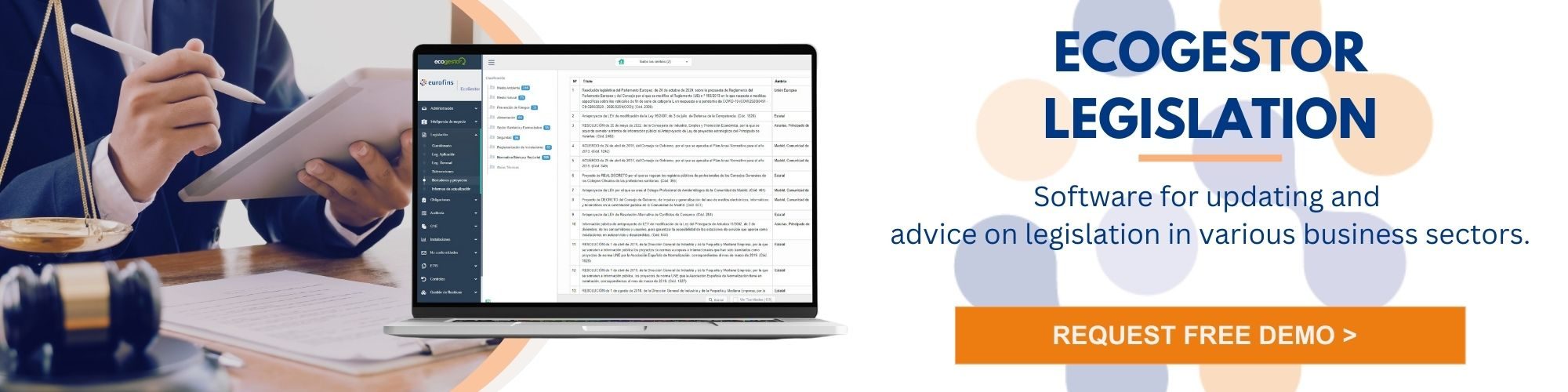
At Eurofins Environment Testing Spain, we offer you a comprehensive solution: EcoGestor Legislation. This digital tool allows you to automate the control of your legal obligations and facilitates their efficient compliance. Its main advantages include:

  • Personalised identification of the legal requirements applicable to your activity.
  • Clear and schematic extraction of what each regulation requires: EcoGestor tells you, directly, exactly what your company must do to comply with each specific regulation, without ambiguities or unnecessary technicalities.
  • Centralised management of tasks, people in charge, key dates and documentation.
  • Real-time alerts and updates on legislative changes affecting your business.
  • Comprehensive coverage in areas such as environment, occupational safety, quality, data protection and industrial safety.

In addition, EcoGestor Legislation is also available in Portugal, Italy, Peru and France, allowing business groups with an international presence to manage their legal compliance in a unified way and adapted to each country.

EcoGestor Legislation can be seamlessly integrated with other solutions in the EcoGestor ecosystem, such as:

  • Contractor Management (Coordination of Business Activities)
  • CMMS (Computer Aided Maintenance Management)
  • PPE (Personal Protective Equipment Management)
  • Waste (Control of waste generated and its traceability)

This integration makes it possible not only to know what the regulations require, but also to take operational control of compliance, converting legal knowledge into real, planned and documented actions within the system.

Eurofins EcoGestor: your strategic partner in regulatory compliance

In a context of constant change, having a team of expert consultants like Eurofins EcoGestor makes all the difference. Our unit specialising in environmental legislation and regulatory compliance works to help you keep your organisation within the legal margins and turn that obligation into a competitive advantage.

verification of regulatory compliance

Compliance: a growing need for risk-conscious companies

Compliance: a growing need for risk-conscious companies 1200 800 Eurofins EcoGestor

Regulatory compliance: a growing need for risk-conscious companies

In an increasingly dynamic and complex regulatory environment, auditing compliance is no longer a choice, but a necessity. Organizations that do not verify their legal obligations run the risk of sanctions, reputational damage and loss of competitiveness. But how can they deal with all this effectively?

Why regulatory compliance is crucial today

Companies operate in regulated environments where environmental, occupational health and safety, quality or waste management laws are constantly changing. A regional decree, a change in enviromental codes, a new ISO requirement… any regulatory change can have a direct impact on your business.

In addition to the legal obligation, verifying regulatory compliance helps to anticipate risks, prevent accidents, improve internal organization and, most importantly, demonstrate the company’s commitment to responsible and sustainable management.

The limits of traditional management

Many companies still manage regulations usingf Excel sheets, manually downloaded PDFs or occasional checks. This approach exposes them to errors, oversights and lack of traceability. Moreover, it is often disconnected from day-to-day operations, making it difficult to prove compliance in the event of audits, inspections or certifications.

Digitization as an ally of compliance

To overcome these obstacles, more and more companies are adopting digital solutions that simplify and automate regulatory management. A centralized platform enables them to:

  • Keep legislation applicable to their business up to date..
  • Receive automatic notifications of legislative changes.
  • Manage corrective actions with full traceability.
  • Prepare confidently for external checks and audits.

EcoGestor Legislation: The Effective Response for Compliance

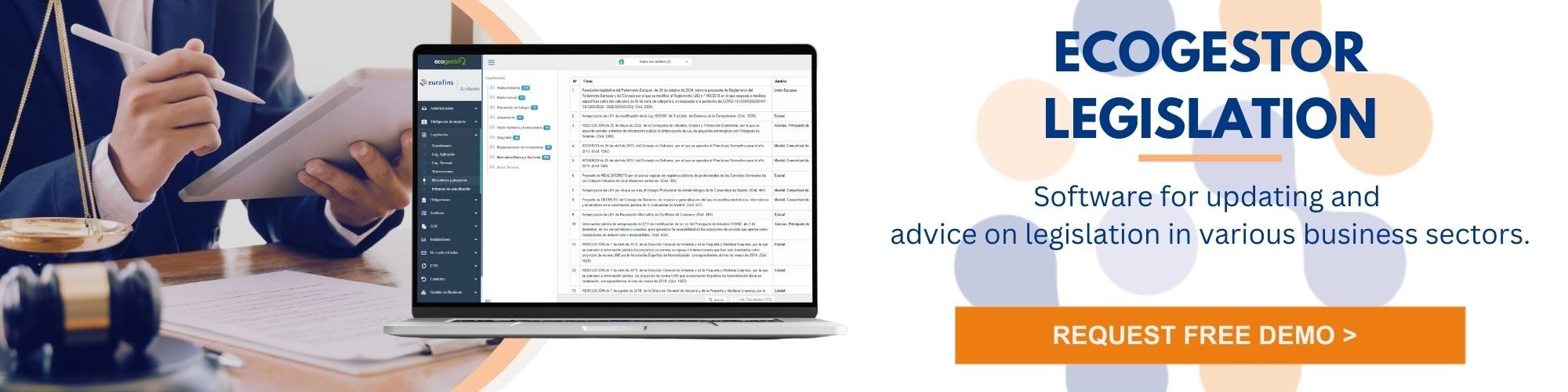
EcoGestor Legislation is the software of choice for companies that want to manage their regulatory obligations intelligently. Based on cloud technology, it allows users to consult and monitor current legislation in real time, receive customized updates, and integrate compliance with their business processes.

With a daily updated legal database and  support from specialised consultants, EcoGestor Legislation offers security, efficiency, and peace of mind in compliance management.

Recommended business unit

EcoGestor Legislation is a solution developed by Eurofins , with years of experience in environmental, regulatory and workplace safety management. 

Need to optimize the management of your company’s legal requirements? Request a demo of EcoGestor Legislation and find out how we can help.

EcoGestor legislation